NASA’s Voyager 1 spacecraft finally phones home after 5 months of no contact
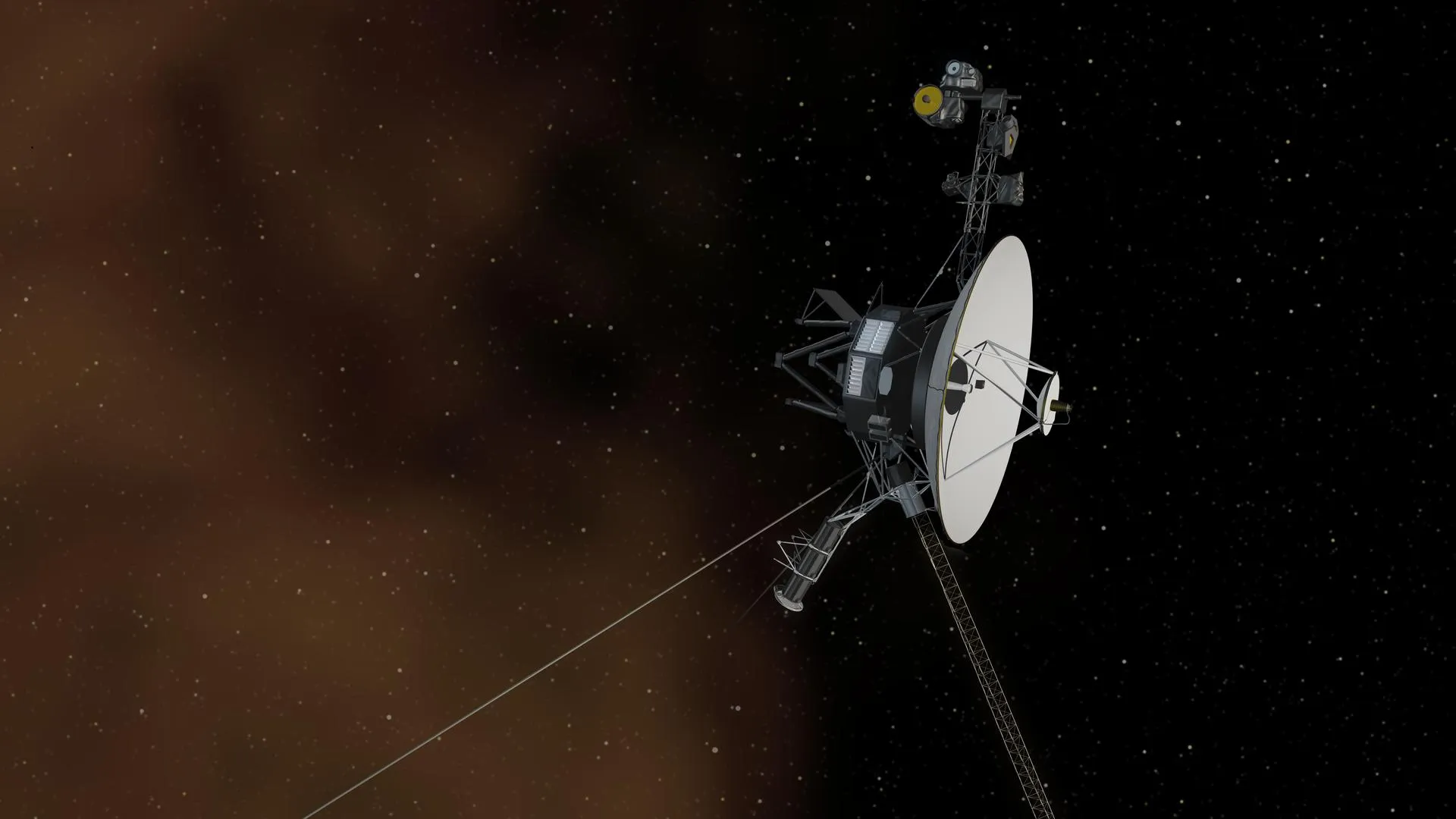
Voyager 1, launched in September 1977, is currently exploring the farthest edges of the solar system. (Image credit: NASA)
NASA’s interstellar explorer Voyager 1 is finally communicating with ground control in an understandable way again. On Saturday (April 20), Voyager 1 updated ground control about its health status for the first time in 5 months. While the Voyager 1 spacecraft still isn’t sending valid science data back to Earth, it is now returning usable information about the health and operating status of its onboard engineering systems.
Thirty-five years after its launch in 1977, Voyager 1 became the first human-made object to leave the solar system and enter interstellar space. It was followed out of our cosmic quarters by its space-faring sibling, Voyager 2, six years later in 2018. Voyager 2, thankfully, is still operational and communicating well with Earth.
The two spacecraft remain the only human-made objects exploring space beyond the influence of the sun. However, on Nov. 14, 2023, after 11 years of exploring interstellar space and while sitting a staggering 15 billion miles (24 billion kilometers) from Earth, Voyager 1’s binary code — computer language composed of 0s and 1s that it uses to communicate with its flight team at NASA — stopped making sense.
In March, NASA’s Voyager 1 operating team sent a digital “poke” to the spacecraft, prompting its flight data subsystem (FDS) to send a full memory readout back home.
This memory dump revealed to scientists and engineers that the “glitch” is the result of a corrupted code contained on a single chip representing around 3% of the FDS memory. The loss of this code rendered Voyager 1’s science and engineering data unusable.
The NASA team can’t physically repair or replace this chip, of course, but what they can do is remotely place the affected code elsewhere in the FDS memory. Though no single section of the memory is large enough to hold this code entirely, the team can slice it into sections and store these chunks separately. To do this, they will also have to adjust the relevant storage sections to ensure the addition of this corrupted code won’t cause those areas to stop operating individually, or working together as a whole. In addition to this, NASA staff will also have to ensure any references to the corrupted code’s location are updated.
On April 18, 2024, the team began sending the code to its new location in the FDS memory. This was a painstaking process, as a radio signal takes 22.5 hours to traverse the distance between Earth and Voyager 1, and it then takes another 22.5 hours to get a signal back from the craft.
By Saturday (April 20), however, the team confirmed their modification had worked. For the first time in five months, the scientists were able to communicate with Voyager 1 and check its health. Over the next few weeks, the team will work on adjusting the rest of the FDS software and aim to recover the regions of the system that are responsible for packaging and returning vital science data from beyond the limits of the solar system.